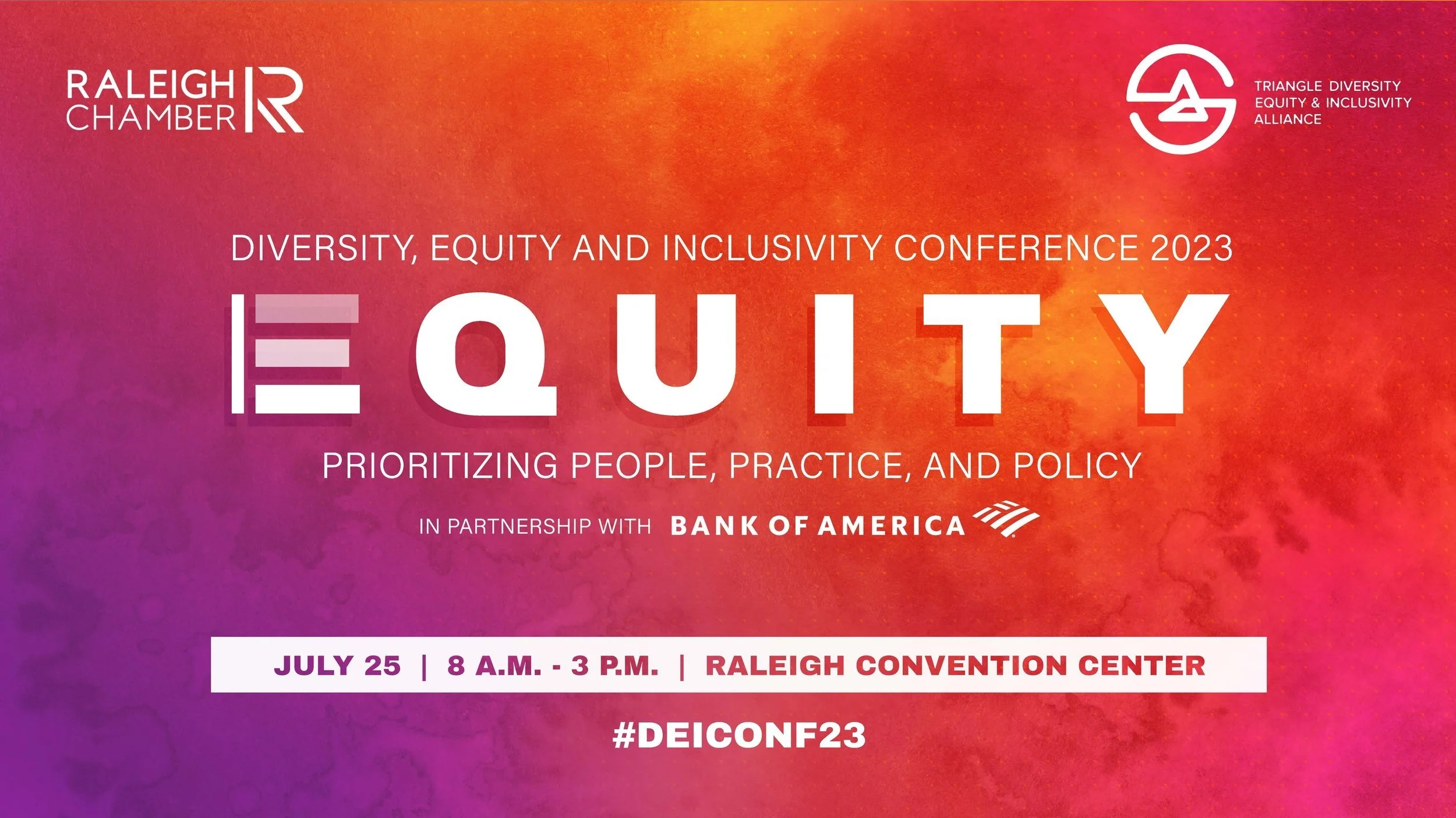

2023 DEI Conference
Equity: Prioritizing People, Practice, and Policy
July 25, 2026
Countdown to the Conference
Is your company seeking to initiate conversations about diversity? Are you exploring opportunities to build an inclusive work culture? Is your company a “pro” and looking to move from good to great? Regardless of where you are in your diversity, equity, and inclusivity (DEI) journey — this conference is for YOU.

Networking Opportunities

Global DEI Thought Leaders

Tips, Tools and Strategies

Authentic Conversations
Key Learning Moment
-
Sharing Our DEI Journey
Each expert will give a 7–10-minute talk about their journey into DEI work.
• John Samuel | ABLR
• Donald Thompson | The Diversity Movement
• Representative | Fidelity Investments
-
Environmental, Social, and Governance and DEI Panel
This panel will discuss the importance of DEI to ESG.
• Rashid Beyah | Merck
• Sabrina Colón | HDR
• Duane Holder | Wake County Government
• Crystal Taylor | Black Farmers Market
• Felicia Woodard | Bank of America [Moderator]
Speakers
-
Panel: Building Bridges Through a Diversity Equity and Inclusions Lens– People
Iris Green, JD, Director of Constituent Services, Disability Rights NC
Curtis Hill, Advocate, Disability Rights NC
Monica Resendiz, Community Engagement Support, Disability Rights NC
Vivianette Ortiz Caravbello, Bilingual CASE Intake Advocate, Disability Rights NC
Many groups of people have been historically excluded from involvement in communities and continue to face barriers to civic participation. This presentation is a guide for embedding Diversity Equity and Inclusion (DEI) into community infrastructure to help ensure that historically marginalized populations are appropriately engaged in all aspects of their communities. Learn about the benefits of DEI and strategies that have been used to build bridges so that communities are empowered and positioned for growth for all its constituents.
Learning Outcomes:
• Attendees will learn about the benefits of centering DEI in outreach advocacy.
• Attendees will learn about effective strategies that have been used to maximize outreach efforts to historically marginalized communities.
• Attendees will learn about the impact of increased outreach efforts using DEI lens.
-
Panel: The Impact of State LGBTQ Legislation - Policy (Panel)
Panelists:
Deanna Jones, Deanna Jones Now Diversity Consulting
Stan Kimer, President and Owner, Total Engagement Consulting by Kimer
Eric Martin, LGBTQ Resource Center Coordinator, North Carolina Central University
Susie Silver, Senior Consultant & Innovation Strategist, The Diversity Movement
Description: This year in North Carolina and many other states across the country, state legislatures are introducing and passing laws that affect LGBTQ (Lesbian, Gay, Bisexual, Transgender, Queer) people. These laws have business, community, and personal impact, and because of intersectionality, ramifications can be felt far beyond the LGBTQ community. This panel discussion will feature business and community leaders sharing about the impacts of these laws.
Learning Objectives
• Learn about the various LGBTQ laws being currently proposed in the North Carolina legislature.
• Understand the impact these laws have on businesses, communities, and individuals.
-
Panel: Why Being Radically Inclusive is a Businesses Advantage - Practice
Mary Angelini, Co-founder of Gabi’s - Powered by Special Abilities
Gabi Angelini, Co-founder of Gabi’s - Powered by Special Abilities
Kiersten Wolf Williams. Vice Chair, Marketing Director, & Secretary of Gabi’s - Powered by Special Abilities
This engaging session will feature award-winning entrepreneur Gabi Angelini of Gabi’s Powered by Special Abilities and her co-founder mom, Mary Angelini. This duo will share the importance of diversity on your entire workforce and specific steps you can take to help empower all of your employees, finding their superpowers along the way.
Learning Objectives
• Statistics about the employment of people with special abilities
• Unique skill sets and challenges.
• Benefits for the entire workforce.
• Steps for making your workforce more diverse.
-
Panel: Starting Your DEI Journey – People/Practice/Policy
Antoinetta Mosley, Founder, I Follow The Leader, LLC
Demetrius Edwards, Senior Community Relations Analyst, City of Raleigh
Shenette Swann, Guest Engagement Manager of Inclusion/programs, Marbles Kids Museum
Katy Werlin, HR Generalist, REDGRAVE LLP [Moderator]
This session will provide insight for organizations that are looking to begin their DEI journey and become more active in the DEI space.
Learning Outcomes:
• Learn some simple things that don't require funding but will create an impact.
• Understand some of the common pitfalls organizations face when first engaging with DEI.
• Understand the importance of making DEI part of your organization's strategic plan.
-
Panel: Hiring a New Generation of Employees (Panel) - Practice
L’Asia “Asia” Jackson, Junior Exercise Science Pre-Athletic Training Major, Shaw University
Akshata Malur, Graduated form the Master of Arts in Industrial-Organizational Psychology , Meredith College
Madison “Maddie” Sealey, Junior Double Major in Criminal Justice and Psychology, William Peace University
Cricket Wellum, Associates’s in Office Professional Administration, Wake Technical Community College
Participants will hear from a panel of graduate and undergraduate students from diverse majors and educational backgrounds on the Equity practices that need to be present for them in an organization when applying for permanent and full-time positions.
-
It’s What You Say and How You Say It - Practice/ People
Dr. Linda Wiley Bing – Founder of Turning Point LG
Description: Organizations around the world are looking for ways to increase feelings of inclusion and belonging among their employees. Most look at policies and practices but few consider the way we speak to one another with specific communication patterns. Words have the power to build people up, encourage, and motivate them. We help people believe in themselves and their abilities by what we say to them. Conversely, words can also be a form of microaggressions that tear people down. You can create situations where people feel unworthy, unskilled, unmotivated and more. This webinar will introduce the “4 tongues” which are common patterns of communication. We will explore their potential impact, and tips for how to tame your tongue and transform your organization.
Learning Objectives:
• Explore 4 communication types and their potential impact
• Learn how to discover your communication type with access to a free assessment
• Examine factors that impact your communication pattern
• Look at the relationship between communication patterns and employee feelings of inclusion
• Discuss ways to close the employee inclusion gap by “taming your tongue”
-
Maximizing the Impact of Employee Resource Groups (ERGs) - People
Jamie Ousterout of The Diversity Movement
Description: Employee resource groups can provide a wonderful sense of inclusion and belonging at organizations for historically marginalized groups. However, ERGs require the proper structure and stewardship to be successful. The session can apply to both organizations that have not yet established ERGs and those that have already instituted ERGs.
Learning Objectives:
• Understanding the definition and history of ERGs
• Receive guidance on how to establish and maintain ERGs.
• Learn best practices and how to avoid common ERG pitfalls.
-
Beyond Recruiting: Amplifying Inclusion & Equity on your Team - People
Chelsea C. Williams, Founder, and CEO of ReImagine Talent Co.
Description: So you’ve made organizational progress on diversity and elevated representation by hiring underrepresented populations, now what? Given heightened conversations on employee experience and well-being, organizations must ensure that diversity efforts don’t just stop at recruiting but expand to support employee development and belonging.
This session will support people managers & leaders in fostering inclusive & equitable teams. The session will focus intently on the nuances of managing & leading diverse teams (by identity and within varying work dynamics i.e. remote, hybrid).
Learning Objectives :
• Explore how to go beyond recruiting towards a people experience centered on employee wellbeing and retention.
• Explore common pitfalls in fostering inclusive and equitable teams.
• Explore manager traits essential for success and practical strategies for building connection, collaboration, and productivity.
• Leverage the Reimagine Talent™ “3 Rs framework” as a pillar for managerial success -- recognize, respond, and resolve.
-
Let’s Get Serious About Pay Equity: Policy Decisions & Why They Matter in Equity
Kasey Ashton, EdD Director of Wake Invests in Women College Initiatives and Assessment at Wake Technical Community College
The mission of Wake Invests in Women (WIIW) is to close the gender wage and representation gaps for women in Wake County. WIIW aims to use research-based strategies that have the greatest potential for increasing the representation of women and reaching pay parity with men in high-demand, high-growth, and high-wage occupations where supply outpaces demand. Black and Latina women, in particular, continue to be significantly underrepresented in high-demand, high-earning occupations such as software development and are experiencing a significant gap in earnings compared to their male counterparts. WIIW acts as a focal point for innovation by creating an extensive, collaborative network of organizations (private, public, government, and non-profit) working together to close gender wage and representation gaps in Wake County.
Learning Outcomes:
• Impact of pay equity on recruitment and retention.
• Brief review of pay equity and transparency laws.
• Recommended practices for pay equity policies.
-
Liberatory Design - Practice
Ashley Ahlers, Director – Justice Philanthropy United Way of the Greater Triangle
Danielle Lake, The Center for Design Thinking, Elon University
How might we move from contributing to cycles of oppression towards those of liberation? Liberatory design offers strategies. As a process for cultivating complex social changes, liberatory design supports efforts to recognize oppressive social systems, imagine alternative possibilities, and codesign more inclusive and just processes for those most impacted. Participants in this session will learn about how cycles of socialization play a role in our lives, actions, and mindsets. They will explore opportunities for unlearning oppressive cycles, generate actionable strategies for transformation, and leave with prototypes for creating more inclusive, equitable, and just professional, civic, and personal communities.
Learning outcomes:
• Learn about how cycles of socialization shape our actions and mindsets.
• Explore opportunities for unlearning oppressive cycles.
• Generate actionable strategies for creating more inclusive, equitable, and just professional, civic, and personal communities.
-
Beyond Likes and Shares: Using Social Media to Drive Equity and Inclusion in Organizations– People/Practice
Micheal Shaw, President of Micheal Shaw Inc., Team Jenny Bean
"Beyond Likes and Shares” is an engaging and interactive presentation that explores the power of social media for promoting equity and inclusion in organizations. Participants will learn how to use social media to advance equity goals and build their brand while also engaging with their audience in meaningful ways. Through examples, case studies, and best practices, this presentation will equip participants with the knowledge and skills to create a socially conscious brand and promote equity in their organizations through their social media strategy.
Learning Objectives
By the end of "Beyond Likes and Shares” presentation, participants will be able to:
• Understand the importance of promoting equity and inclusion in their organizations and the role of social media in achieving this goal.
• Identify the key equity goals of their organization and align them with their social media strategy.
• Choose the right social media platforms and develop a content strategy that supports their equity goals.
• Engage with their audience and build relationships to foster dialogue and encourage feedback.
• Use data and analytics tools to measure and analyze their social media performance and make informed decisions for improving their equity-focused social media strategy.
• Implement best practices and examples for promoting equity and inclusion through social media channels.
• Leave with actionable takeaways and next steps for implementing a socially conscious brand and promoting equity in their organizations.
-
Effective Strategies to Start, Grow or Expand an Impactful Supplier Inclusion Program- Policy
John Ham, VP – Center for Professional Services, National Institute of Minority Economic Development
There has never been a more urgent time for procurement organizations to invest in supplier diversity & inclusion. The increased focus on diversity, equity, and inclusion (DEI) resulting from the social unrest in the United States has put pressure on procurement leaders to respond. And they are: In a 2020 Gartner survey, 74% of procurement organizations said they intend to expand their use of diverse suppliers over the next 12 to 18 months. For those companies, the question then becomes: How do we build a supplier diversity program that will drive sustainable, long-term value? This session will show you how.
-
Fostering Collaboration With Small Businesses – People/Practice
Lori Diaz, VP – Business Solutions, Carolina Small Business Development Fund
Reginold Jones, Director - Business Solutions, Carolina Small Business Development Fund
Participants will learn how public and private entities diversify their vendor pools. As well as understand the power of partnership, and gain resources for technical assistance and access to capital.
-
Organizational Culture and Racial Equity (Part 1)
Workshop Description: Historical and current efforts to achieve transformative racial equity in organizations have been insufficient. The organization can experience dissonance and tension that can arise between organizational commitments and goals to achieve racial equity and the regenerative nature of organizations to reproduce themselves to match how it has historically existed.
This interactive workshop seeks to identify challenges to becoming racially equitable by examining the role of organizational culture and its influence on performance and behavior regarding racial equity. Organizational culture is presented as a set of underlying beliefs, assumptions, values, and ways of interacting that contribute to an organization's unique social and psychological environment. It is a way to look discuss behavior and patterns of whole organizations (Schein, 1996).
Part 1: Participants will engage in an interactive discussion of the three levels of organizational culture: artifacts, espoused beliefs and values, and basic underlying assumptions. Presenters will introduce the concept of habitus, which can impact individual and collective decision-making based on commonly held expectations, attitudes, dominant narratives, and aspirations and how habitus operates in the workplace.
-
Organizational Culture and Racial Equity (Part 2)
Workshop Description: Historical and current efforts to achieve transformative racial equity in organizations have been insufficient. The organization can experience dissonance and tension that can arise between organizational commitments and goals to achieve racial equity and the regenerative nature of organizations to reproduce themselves to match how it has historically existed.
This interactive workshop seeks to identify challenges to becoming racially equitable by examining the role of organizational culture and its influence on performance and behavior regarding racial equity. Organizational culture is presented as a set of underlying beliefs, assumptions, values, and ways of interacting that contribute to an organization's unique social and psychological environment. It is a way to look discuss behavior and patterns of whole organizations (Schein, 1996).
Part 2: Participants will engage in an interactive activity to more closely focused on the third level of organizational culture, underlying assumptions (beliefs), embedded in organizations, which can have the greatest influence on performance and behavior. Presenters will offer tools that can be useful to an organization interested in understanding their culture.
Thank You To Our Sponsors
In Partnership With
Presenting Sponsors
Platinum Sponsors


Gold Sponsors
Enact
Girl Scouts - North Carolina Coastal Pines
North Carolina Education Lottery
Piedmont Health Services, Inc.
Raleigh Regional Association of Realtors
Research Triangle Foundation of North Carolina
UNC Health
Woldspeed, Inc.
Piedmont Health Services
Bronze Sponsors
AT&T North Carolina
Brasfield & Glorrie LLC
Blue Cross and Blue Shield of North Carolina
Clancy & Theys Construction Co.
First Citizens Bank
Gilead Sciences
Highwoods Properties, Inc.
Hire Strategies, LLC
Mattingly Solutions
NC State University Advancement
Paradox Consulting Partners
Triangle Commercial Real Estate Women (TCREW)
Wake Technical Community College
Silver Sponsors
IBM Corporation
Marsh & McLennan Agency
Poyner Spruill LLP
United Way of the Greater Triangle
WakeMed Health & Hospitals
YMCA of the Triangle Area
Breakout Session Sponsor
FUJIFILM Diosynth Biotechnologies
TrialCard
Media Sponsors
ABC-11 Eyewitness News (WTVD)
CBS 17
Univision 40
AV Sponsors
Tech Factory Productions